

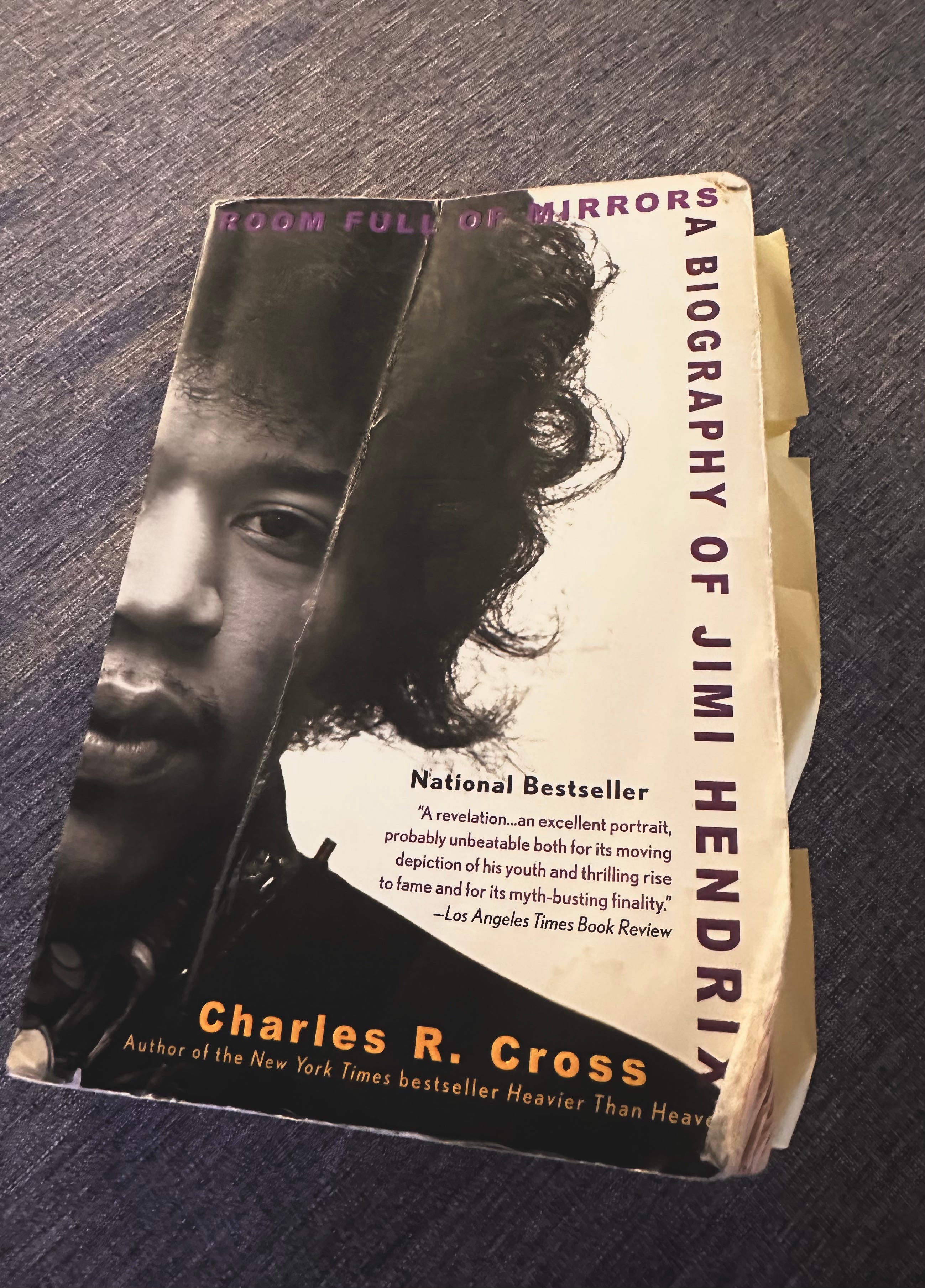
I recently read Charles R. Cross’s book, Room Full of Mirrors: A Biography of Jimi Hendrix, published in 2005. For twenty years, I avoided doing so, mostly because of the sensationalist marketing and press coverage upon its publication, which focused heavily on Cross’s novel, but highly dubious, assertion that Jimi pretended to be gay in order to receive a discharge from the US Army. (I won’t touch that topic in this post, as I plan to address it head-on later this year.) The book is, however, widely regarded by the mainstream press, and I suspect that a person looking to read a Hendrix biography today might be led to believe that Room Full of Mirrors is the definitive account and the place to start. Therefore, it must be taken seriously.
Room Full of Mirrors is an entertaining read, and there is a lot of new reporting, but its value is overshadowed by its serious factual problems. The unfortunate truth is that the book is replete with errors and outright falsehoods that are inexcusable for any biographer or historian. This is quite puzzling, because it’s clear that Cross conducted an impressive and extensive amount of research. Cross writes that he spent four years on this project, and it shows in many ways. The book paints a multidimensional picture of the man, and there are interesting discoveries presented. The problem is that the errors are so numerous, and much of what is written is so easily disproven, that the book lacks credibility.
Inaccuracies, Mistakes, and Outright Falsehoods
The first sign of trouble comes pretty early into the book. Cross, citing Jimi’s brother Leon, explains that “Castles Made of Sand” was written about their mother, who tragically died when Jimi was a teenager:
Years later, Jimi would write his most autobiographical song, “Castles Made of Sand,” and refer to a woman in a wheelchair whose “heart was a frown.” . . . . The song begins with a domestic spat, and the wife slams a door on her drunken husband. Another verse tells a tale of a young boy who plays in the woods, pretending he is an Indian chief. The crippled woman eventually decides to take her own life by jumping into the sea, pleading, “You won’t hurt me no more,” as she leaps. She lands on a “golden winged” ship. Jimi ends the song with a couplet about timelessness, using the image of “castles made of sand” washing into the sea.
“Castles Made of Sand” is one of Jimi’s most beautiful and poignant songs, and it was almost certainly autobiographical, at least in part. But somehow Cross gets it wrong. The last verse isn’t about an adult; it’s about “a young girl.” She doesn’t land on the golden winged ship; she sees the ship and it moves on:
There was a young girl whose heart was a frown
‘Cause she was crippled for life and she couldn’t speak a sound
And she wished and prayed she could stop living
So she decided to die
She drew her wheelchair to the edge of the shore
And to her legs she smiled, “You won’t hurt me no more”
But then a sight she’d never seen made her jump and say
“Look, a golden winged ship is passing my way”
And it really didn’t have to stop
It just kept on going
Either Cross never really spent time with the song, or, more likely, he fudged it because the parallel to Jimi’s mother isn’t as clear as he’d like it to be. (He also misses the cleverness of Jimi’s lyrics. The girl in the story was paralyzed and mute, but, upon seeing the ship, jumped up and spoke.) These are minor points, of course, but the passage is representative of Cross’s willingness to play fast and loose with the facts in service of his narrative.
Cross’s account of Jimi’s groundbreaking performance at the Monterey Pop Festival in June 1967, which he closed by lighting his guitar on fire and smashing it after an outrageous performance of “Wild Thing,” is another good example of this:
Jimi’s only real miscue came at the end of “The Wind Cries Mary” when his guitar went wildly out of tune. Switching instruments was not an option: Jimi had painted the Strat for the occasion. He plowed through “Purple Haze” using feedback, which didn’t need to be in tune.
But Jimi didn’t even use the painted Strat for “The Wind Cries Mary”! As any serious fan knows, he played most of the show with a different guitar, a black Strat that he favored in 1967. (The provenance of that guitar is an interesting story unto itself.) He switched to the famous red Strat, specifically painted and prepared for its on-stage sacrifice, to play “Wild Thing.” This type of stuff doesn’t demand much effort to figure out. The entire performance was filmed and is easily available:
Perhaps the most egregious errors appear in Cross’s narrative of the Experience’s final performance, at the Denver Pop Festival on June 29, 1969:
Rather than entertaining the crowd, Jimi antagonized them, changing the lyrics of “Voodoo Child” to “Gonna make a lot of money and buy this town / Gonna buy this town and put it all in my shoe.”
This is utter nonsense that made my jaw drop. Jimi didn’t “change” the lyrics to “Voodoo Child.” Those are lyrics to an entirely different song, “Hear My Train A Comin’,’” a concert staple that Jimi performed at least 40 times during his career (with some lyrical variation). Anyone who has spent any time listening to Jimi’s music should know this. Later in the book, Cross himself even writes about Jimi’s performance of the song in Berkeley in 1970! The Denver show was also recorded, and the tape has circulated among collectors for decades. Ironically, it was a rare instance in which Jimi didn’t even play “Voodoo Child!”
Cross’s fictional account continues:
At one point during the set, he announced, “This is the last gig we’ll ever be playing together.” Spurred on by that declaration and by continual clashes with the police, rioting broke out among the seventeen thousand people inside the stadium, with many trying to climb on stage. When the police shot tear-gas canisters into the audience, Jimi joked, “We see some tear gas—that’s the sign of the Third World War.”
Despite apparently having access to the tape, Cross makes some seemingly minor, but important, departures from reality. The tear gas had been shot before the show started (and during), and Jimi joked about “the Third World War” upon taking the stage, not mid-performance. And while there are plenty of interesting examples of Jimi antagonizing or insulting his crowds, this wasn’t one of them. His comment about “the last gig” is a curious one, but there’s no evidence from the tape or any other source that the audience had any reaction to, or even registered, the remark. On the garbled audio, we also hear a qualification that Cross omits. (To my ears, it sounds like, “in the States”). Regardless, Cross’s agenda is clear.
The narrative closes with another goof. Cross writes that, after Noel left the group following the Denver show, “Jimi attempted to track down Billy Cox” but had difficulty finding his old army buddy. The truth is even more interesting: Jimi had tracked down Billy months earlier and had already been recording with him long before the Denver show. As John McDermott reports in his excellent resource, Jimi Hendrix: Sessions, which predated Cross’s book by 10 years:
When Jimi was touring with the Experience in Memphis (April 18), he reached out to his old army buddy, Billy Cox. . . . Cox agreed to come up to New York as soon as he could put his affairs in order. He left a few weeks later to record with Jimi. . . . As Jimi and Noel saw increasingly less of each other, Cox and Redding avoided the possibility of any embarrassing moments in the studio from their bumping into each other.
McDermott details Jimi’s recording sessions with Billy at the Record Plant in New York, beginning on April 22, 1969, including the excellent “Mannish Boy,” posthumously released on the necessary Jimi Hendrix: Blues compilation. Several other tracks featuring Billy Cox on bass recorded before Denver have since been released. An honest biographer would have explored this: why, for example, did Jimi reach out to Billy Cox mid-tour without dropping Noel? How did Noel feel about that, and did it affect the performances?
These are just a few examples. Some are simply amusing, like when Cross tells the reader that Jimi wrote lyrics on “stolen hotel stationery.” Stolen? Had Cross ever stayed in a hotel before? While it’s impossible to know the reason Cross did things like this—particularly since he passed away in 2024—the sense that I get is that he prioritized his constructed narrative of Jimi’s life over factual accuracy. Maybe I’m naive, but I don’t think that is how journalism—even lowly rock journalism—is supposed to be done.
The Good Parts
Notwithstanding all of these serious problems, the book is excellent in a number of places, particularly the early chapters on Jimi’s ancestry and upbringing, as well as the cultural and musical history of Seattle. Cross clearly worked very hard to track down Jimi’s family members, childhood friends, and others who knew him well, and to uncover letters and other documents that hadn’t been previously reported.
The first two chapters cover nearly 70 years before Jimi’s birth in 1942. Even for someone without an interest in Jimi or his music, it’s a fascinating overview of the history of Black Americans in the Pacific Northwest, including Vancouver. With access to archival records, Cross traces Jimi’s family tree with a level of detail deeper than I had read before. It’s a compelling—and incredibly sad—account of unimaginable multigenerational trauma. It’s difficult to present that history here in any way that would give it justice. These chapters alone make the book a worthwhile read.
Cross also reveals Jimi’s deeply traumatic childhood: absentee and alcoholic parents, passed from one family friend or aunt to the next, multiple siblings given up for adoption or put into foster care, changing schools multiple times per year, etc. He also shows the love that his family and friends had for him, including several who cared for him when others didn’t. Cross tracked down many of these people, including Jimi’s childhood and teenage friends, who share a number of personal anecdotes that shed light on a little known side of Jimi. Cross also appears to have had access to private letters and other correspondence (like postcards) that I don’t recall seeing before. Some of these are so personal—particularly a long, rambling, and emotional letter Jimi wrote to his dad not long before he died—that it felt wrong to even read them.
There is also some great stuff on the Seattle music scene of Jimi’s teenage years: the local bands Jimi listened to and saw, the local venues (like The Spanish Castle), and the local players. Cross’s career as a Seattle-based music journalist gives him a level of expertise that comes through very clearly.
And, finally, Cross’s accounts of Jimi’s brief returns to Seattle after achieving stardom are detailed and fascinating. Most notably, citing Jimi’s relatives and friends, Cross tells how, during his last visit to Seattle, Jimi went on a personal, historical tour of the city, visiting his various schools and homes and hangouts, and reflecting on how far he had traveled from where he came from.
Final Thoughts
The title of the book, Room Full of Mirrors, was a deliberate and meaningful choice. Cross explains:
The song “Room Full of Mirrors” tells the story of a man trapped in a world of self-reflection so powerful it haunts him even in his dreams. He is liberated after smashing the mirrors, and wounded from the shattered glass, he seeks an “angel” who can give him freedom. Holding the physical manifestation of this concept—the broken mirror artwork that Jimi’s father kept in his basement—one cannot help but think of the deep complexity of the man who created this song, and think of the day Jimi Hendrix stared at fifty slivers of his own reflection in this piece of art. “All I could see,” he sang in the song, “was me.”
He returns to this motif a few times, and, more broadly, it functions almost as a thesis statement for his story of Jimi’s life. It’s also the book’s central weakness. Cross had a story he constructed and wanted to tell: it’s a very sad one that paradoxically paints Jimi as both a victim of circumstance and as bearing sole responsibility for his own fate. One gets the sense that, having chosen this as his thesis, Cross was determined to justify it by taking excessive liberty with the facts, disregarding contrary evidence, and by inserting an unfair, subjective moralization throughout. His closing thoughts on Jimi’s death are particularly crass:
[T]here would be no angelic rescues on the overcast morning of September 18, 1970, and the circumstances and choices that had led Jimi to this hotel room, and this fate, were solely of his making. Though a young woman was sleeping near him, she was a stranger really, and Jimi was, for all practical purposes, alone with his fate.
Room Full of Mirrors was an apt title for an unintended reason: it’s hard to tell what’s true and what isn’t.
What’s the best Hendrix biography out there??